- Go 99.5%
- Shell 0.3%
- Makefile 0.2%
| Filename | Latest commit message | Latest commit date |
|---|---|---|
 nobody
7e917f9c3a
All checks were successful
CI / build (push) Successful in 28m34s
I do not want a build to take every core of the machine that hosts my runner. The job sees all 8 cores, and every Go process in it sized itself for 8. One run pushed the load average past 30 while it compiled golangci-lint, but the build used only about 3 cores; its other threads waited to run. I have not found what limits a build to 3 cores in the sandbox, so I arbitrarily picked 4. `make security-check-deps` compiled gosec from source on every push. The CI image now has gosec at a pinned version, and the Security scan step depends on that. The make target is unchanged and still installs @latest. golangci-lint is still compiled on every push. That is most of the CPU time of the job. |
||
| .forgejo/workflows | ||
| assets | ||
| cmd | ||
| constants | ||
| examples | ||
| imgbuilder | ||
| job | ||
| keys | ||
| nettap | ||
| osspecifics | ||
| qemucli | ||
| serious-bug-disclosures | ||
| share | ||
| sshutil | ||
| storage | ||
| third_party/aslint | ||
| tools/golangci-lint | ||
| utils | ||
| vm | ||
| .gitignore | ||
| .golangci.yml | ||
| AGENTS.md | ||
| build-binaries.sh | ||
| CONTRIBUTING.md | ||
| go.mod | ||
| go.sum | ||
| INSTALL_MACOS.md | ||
| INSTALL_WINDOWS.md | ||
| LICENSE | ||
| LINUX_DEV_ENV.md | ||
| main.go | ||
| Makefile | ||
| README.md | ||
| SHELL.md | ||
| TROUBLESHOOTING.md | ||
| USAGE_MACOS.md | ||
| USAGE_WINDOWS.md | ||
Linsk
Linsk is a utility that allows you to access Linux-native file system infrastructure, including LVM and LUKS on Windows and macOS. Unlike other solutions created to access Linux filesystems on unsupported operating systems, Linsk does not reimplement any file system. Instead, Linsk utilizes a lightweight Alpine Linux VM (~130 MB only) combined with network share technologies like SMB, AFP, and FTP.
Because Linsk uses a native Linux VM, there are no limitations on what you can access. Anything that works on Linux will work under Linsk too (hence the Linux+Disk name).
To show your thanks, please star this repository if you found it useful.
💻 Supported platforms
CPU architectures
Linsk natively supports both x86_64 (aka amd64, Intel, AMD, etc.) and aarch64 (aka arm64, Apple M1/M2, and others).
Although Linsk uses a virtual machine, the CPU is never emulated but the hardware accelerators like HVF (macOS), WHPX (Windows), and KVM (Linux) are used.
Operating systems
- Windows
- macOS
- Linux (for development purposes, mostly)
Network file share backends
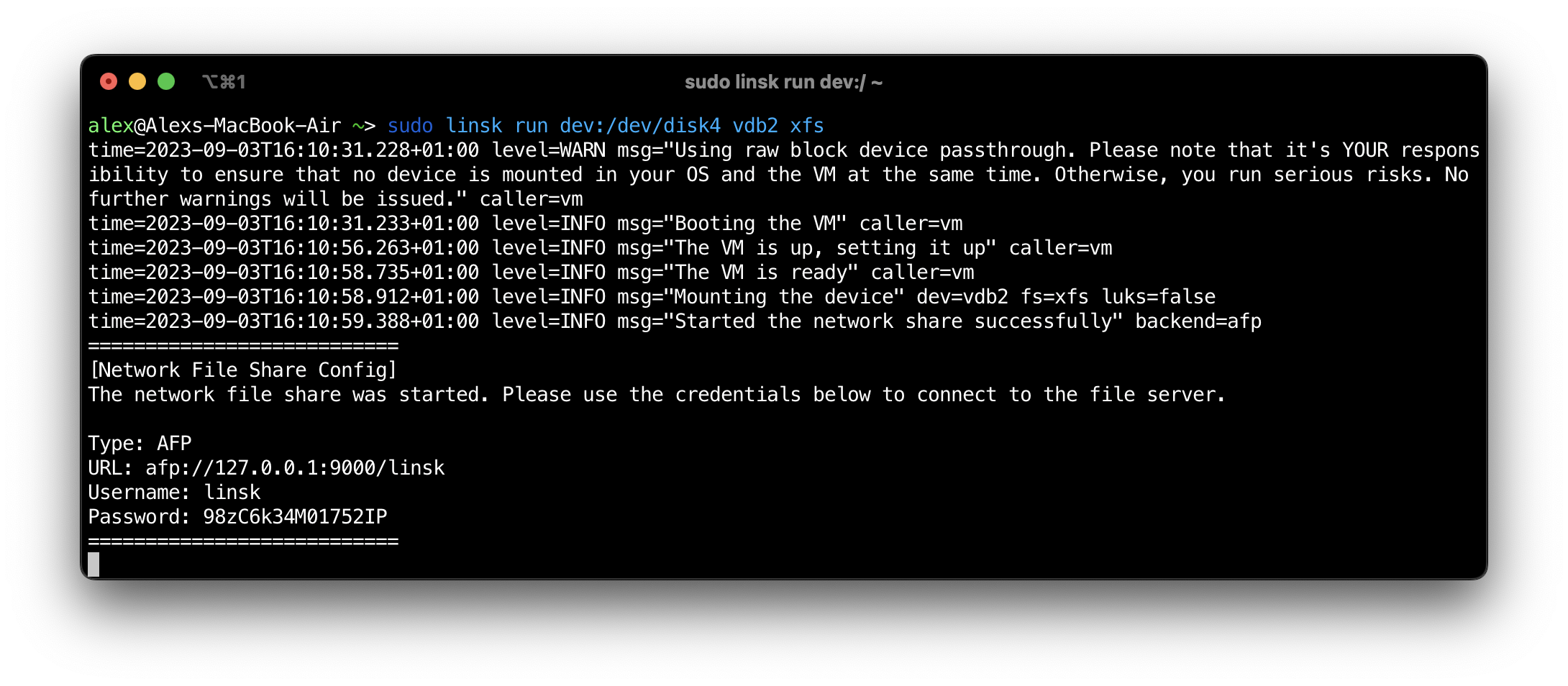
Linsk relies on network file shares to expose files to the host machine. Below are the types of network shares Linsk supports:
- SMB - The default for Windows.
- AFP - The default for macOS.
- FTP - An alternative backend.
💿 Installation
- Windows - See INSTALL_WINDOWS.md.
- macOS - See INSTALL_MACOS.md.
- Linux - Refer to LINUX_DEV_ENV.md.
🔧 Usage
- Windows - See USAGE_WINDOWS.md.
- macOS - See USAGE_MACOS.md.
⚠️ Serious bug disclosures (Obsolete versions)
Linsk versions below v0.2.0 are considered obsolete UNLESS:
- The use of Linsk was limited exclusively to devices with a 512-byte logical block (sector) size; or
- The experimental USB passthrough was used.
More information: serious-bug-disclosures/README.md
👨💻 Contributing
Please see CONTRIBUTING.md.
©️ Copyright and License
Copyright (c) 2023 The Linsk Authors.
Provided under the GNU General Public License v3. The copy of the license is included in the LICENSE file.
Use this git command to view the list of Linsk Authors:
git log --format='%aN <%aE>' | sort -uf